

Throughout time, there have been a total of eight basic plays in basketball. In our first article, we discussed the Two-Step rule for receiving the basketball. This article is the beginning of a series of articles covering the eight-basic fundamental plays of basketball. You better bookmark and return often to keep abreast of each new addition to this subject.
- PLAY #1 (one-on-One)
- PLAY #2 (Give and Go)
- PLAY #3 (Pick and Roll)
- PLAY #4 (Pick Opposite)
- PLAY #5 (Scissors Cut)
- PLAY #6 (Cut Through)
- PLAY #7 (Shallow Cut)
- PLAY #8 (Guard Around)
Play #1 (One-On-One)
Stationary Moves
After a player catches the ball and squares up to the basket in the triple-threat position, he is in ready to attack his defender. This is so called because the player makes the move from a stationary position, before shooting, passing or putting the ball on the floor. All players should practice one-on-one moves every practice session.
Strong-Side Drive
After catching the ball in the triple-threat position, your attacker should execute a jab step. The purpose is to get the defender to react. This step should be made with the right foot by right-handers and the left foot by left-handed players.
The jab step should be short and quick, only about six inches. If the defender does not react quickly enough to the jab step, the offensive player takes a longer step with the same foot, attempting to get his head and shoulders past the defender. The player then should close the gap and explode to the basket with one dribble.
While teaching stationary moves, emphasize the advantage of using the fewest dribbles possible. Keep the head up and pass-off to a teammate, should the defenders collapse on the drive.
Crossover Step
In the course of making a jab step, the defender responds by sliding in that direction, teach your players to react with a crossover step in the opposite direction with a weak-side drive.
For example, a right-handed offensive player catches the ball, jabs with his right foot, forcing his defender to react, taking away the strong-side drive. The offensive player then crosses the right foot over to the left, stepping by the defender’s foot thereby, putting that defender on his right hip. Teach the importance of keeping the body and ball close to the floor as he brings his shoulders through and steps past the defender and puts the ball on the floor with his left hand.
Once again, the offensive player should always attack the defender by going in a straight line to the hoop. Teaching the fundamentals of effective dribbling of keeping the head up, ball low, and closing the gap is as important in the crossover drive as it is in the strong-side drive. When executed properly, either of these moves can lead to an open jump shot or a lay up.
Jab Step to Jump Shot
Defenders usually adjust to the jab step by taking a step backward to prevent a drive to the basket. This retreat gives the offensive player room to go straight up with a jumper if within his shooting range. Every player has his limits, but they don’t often know what it is. As their coach, it becomes your duty to tell them their limitations. This is the best way I know to end losing streaks and start winning games.
To get his shot off, the offensive player must maintain good balance after executing the jab step. He can do this only by keeping the feet shoulder-width apart and staying low. This is why it is important to keep the jab step short (no more than 6 inches). Too long of a jab step forces the offensive player to reset which allows the defense time to recover and block the shot.
All these stationary moves should be part of every practice session. Coach McCutchan always started every practice with players spending 10 minutes between several stations scattered about the gym. On his whistle, every minute, his players quickly moved to the next station. That guy won 5 Division II National Championships and got him in the hall of fame.
Drills for PLAY #1
There are many team drills for the One-on-One Play. I like to use it in conjunction with the Two-Step Drills given in the following examples. Some are strictly instructional; however, most can be put in competitive drills which can be run many different ways. "Make it – take it" is a good method. That is, if the offense makes the basket, he or the team remains on offense. If the offense fouls, it is a turnover. If the defense fouls, the ball remains with the offense. A specific number of "turnovers" can be set up for the offense with score kept. Losers can do push-ups or laps.

The Two-Step Moves by Forward to receive the ball. Use both sides of the court for drills. You can reverse the procedure and have the guards use the two-step rule.
Rule: When making a cut without the ball, take two steps away from the direction you are planning to go and then either cut toward the basket or com back to the ball.
Always demand your guards pass-fake to the two-step to freeze the defense. You may add a defensive guard to this drill.

The Two-Step Moves by all five players. In this case, the Guard is open to receive the ball for an high-percentage open shot.
Rule: When making a cut without the ball, take two steps away from the direction you are planning to go and then either cut toward the basket or com back to the ball.
Always demand your players pass-fake to the two-step to freeze the defense.
Too often, players tend to stand around. The two-step rule teaches them to move without the ball and helps them to understand what you mean when you tell them to read the defense.
-
PLAY #2 (Give and Go)
The second fundamental play, like the first, is as old as basketball itself. Again, every one of your players should be fundamentally strong in this play. The following diagrams illustrate Play #2 used in six different offensive sets.
The give-and-go, often called pass-and-cut, is a basic offensive play in which a player simply passes (gives) to a teammate and cuts (goes) to the basket, attempting to break free of his defender and expecting a return pass from his teammate. If the defender moves with the first pass, or turns his head, the ensuing cut should be quick and straight; however, a fake, feint, change of direction, or change of pace may be necessary in order to draw a reaction from the defender. When they see the give-and-go maneuver initiated, other offensive players must decoy their defenders from the basket area and passing lane. If free to receive a pass, the cutter should raise his hand nearest the basket as a passing signal and target. The pass can be a straight pass, a bounce pass, or a lob pass as the situation warrants.


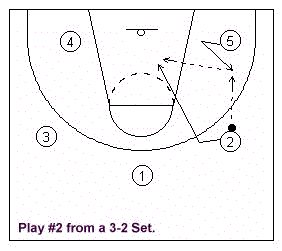


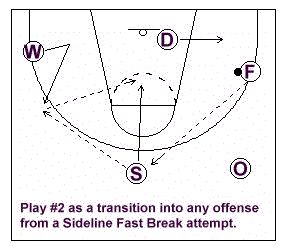
One of the things I always looked for when scouting an opponent was to see what the guard did after passing to a wing. Even today, most coaches key their offense this way, but fail to utilize one of the easiest ways to score in basketball. The guard brings the ball down court, passes to the forward and cuts through the defense to the opposite side; however, the guard rarely looks for a return pass, because he is simply getting the offense started. What a waste! Any coach who allows his players to do this is passing a great scoring opportunity. Let’s always look for a scoring opportunity and put it in the hoop. I’m sure many coaches call this their first option, but the ball seldom ends up in the cutter’s hands. When the first cutter is a definite threat, defensive help on the other options is lessened.
Drills for Number 2
There are many more drills for the give and go than is shown here. Some are strictly instructional; however, most can be put in competitive drills which can be run many different ways. "Make it – take it" is a good method. That is, if the offense makes the basket, he or the team remains on offense. If the offense fouls, it is a turnover. If the defense fouls, the ball remains with the offense. A specific number of "turnovers" can be set up for the offense with score kept. Losers can do push-ups or laps.
-
PLAY #3 (Pick and Roll)
Go to any playground and watch pick-up games. You will see the best two-man play in basketball. It is a play that most every kid understands; however, this does not mean it is always done right. A good coach makes certain the every fundamental play is executed properly. The pick & roll is no different.
The Basics
If you want to give each of your players a chance to do their best thing, play #3 fits right in. The forward, or guard, can call the screen, either verbally or with hand signals. Signaling is important. Here is the law:
If you desire a pick, call for it. If you are picking for a teammate, signal your intention, either by raising three fingers or calling number "3."
In structuring your patterns, you must understand the pick & roll works best when there is less congestion on that side of the floor. Players on the other side should follow this law:
If #3 is being executed do not bring your defender into the area; however, keep him occupied so he cannot sag and congest the play area. Look for a shot to be taken and try to be in a good rebounding position
Guard-Forward or Guard-Center #3
The guard with the ball should always call this play. He may continue with the ball and use the screen himself, or pass to another guard, or wing, for a pick and roll on their specific side of the floor. The following diagrams show the guard with the ball in various sets in a position to call, play #3.


Fundamentals of the Pick and Roll
Before you can execute any of these eight fundamental plays, you must understand all the fundamentals of the play. Many teams use the pick and roll, yet fail to get decent shots. There are others, but here are seven reasons this play fails:
- The screen is not set on the correct position on the floor.
- Improper setting of the screen.
- The screen is not held long enough.
- Failure of man with the ball to maneuver his defender into the screen
- The roll is made incorrectly.
- The pass is deflected or intercepted.
- One, or both players, fail to take advantage of shifts made by defense.
Setting a Good Screen
The front screen is the most basic and should be taught first. In setting this, the player faces the defender to be screened. The rules allow the screener to set his screen as close as possible as long as the defender can see him. Set the screen to his peripheral side.
The legs of the screen should be wide with knees flexed an arms raised in a defensive stance. This makes your body big and allows the referee to see your hands. Too many players set screens like a telephone pole with hands protecting the crotch. This is wrong. Have the hands in the air, ready to catch the ball once the roll is made.
Making a Good Roll
If the legs are wide at the screen, it is easier to make a wide roll. This helps to screen out the defender on a switch. Make the pivot on the foot nearest the basket throwing the outside elbow toward the basket with hand extended as a target for a pass. The butt should make contact with the defender being screened. This puts the defender on the roller’s back should a switch occur. Contact is necessary for best results. Even if the player with the ball shoots, the roller is in excellent rebounding position because he has the man on his back.
Guard Runs the Defender into the Screen
Success or failure of the pick and roll depends largely upon the player with the ball. There must be an inside maneuver to set up the execution. He must master these five fundamental moves with the ball:
- The cross-over step
- cross-over dribble
- behind the back dribble
- reverse dribble
- between the legs dribble
RULE: The player with the ball is responsible to run his defender into the pick once the screen has been set.
Improper Placement of the Screen
If the screen is not set in the proper place on the floor, the defense can easily adjust or does not need to adjust at all. When set in the middle of the floor, the roll is into a congested area. The defense can help and recover too easily. When a pick is set outside, or on a clear side, the defense must make more adjustments, or give up a shot. If the screen is set too far outside, the guard may have a shot beyond his range, then no switch is necessary.
RULE: If the guard is dribbling, let the guard make an inside move first, before setting the screen. Then, let the guard drive his defender into the screen.
Setting a Wide Screen
Another reason the pick and roll fails is because the screen is not wide enough. The screen, whether it be a front or back screen, should be set wide. The feet should be wider than the shoulders, yet the knees should be flexed to take the contact. If the screen is not wide enough, the defense can go over the top or slide through too easily.
If the screen is wide, the screener will take his first step wide to the basket. This also prohibits the defense from switching well enough to cover the roll. The long step produced by the wide screen keeps the defensive guard and the offensive forward’s back. The short step allows the defense to front the roller with less difficulty.
Hold the Screen Long Enough
The screen must be held long enough that the defending guard is screened out of the play. Too many times the forward rolls before the guard is screened and no switch is needed to defend the play.
RULE: The screen should be held until the offensive ball handler is past the screen. The guard should be out of the peripheral vision of the roller before he executes his roll.
Release too early and the play fails; however, if the screen is wide and the switch is made, it really makes no difference when the roll is made. The offense should have the advantage because a guard will now be defending a forward. Even if a shot is taken from the outside, the offense has a better advantage of rebounding a missed shot. If not, the guard can take the ball to the corner and the forward can post up down low with a small defender on his back.
RULE: If the switch is made, especially a jump switch, the guard should try to take the defensive forward to the corner and the offensive forward should post his smaller opponent.
The Incorrect Roll
For some reason, many players turn rather than roll to the basket. A "turn" is a front pivot rather than a reverse pivot. A front pivot turns the offense into the defensive guard causing a moving pick. Also, the forward takes his eyes off his teammate who has the ball. The roll gets you to the basket quicker because the first step is toward the basket. The roll causes the defensive guard to be behind the forward rolling toward the basket. Players must be drilled early in the proper execution of Play #3.
The Incorrect Pass
Whenever a player passes through a defender on any offensive situation, either of two passes may be executed, a bounce pass or a high pass.
RULE: Use only the high pass or a bounce pass in executing the pick and roll.
Defending Play #3
There are four basic ways to defend the pick and roll:
- No switch
- Jump switch
- Slide through
- Help and recover
No Switch
Whether this method is used or not, it should be practiced, especially early in the season. Aggressive players are necessary. Players should be talking constantly on defense and the guards must be quick and have the ability to change directions quickly. Defensively, the "no switch" is the best because the defense never gets involved in a mismatch.
The defensive guard must learn how to beat the screen. To go over the top: step-up, belly-up, and go over the top.
Whenever the defensive forward sees his man going to set a screen, for example, he should, instead of calling "screen left," he should shout, "step-up left." This helps to remind the guard to step-up with his left foot in order to beat the screen. This generally takes a couple of short quick steps to get in front of the screen. Then, the defending guard throws his hip and stomach forward and slides over top of the screen. Using the hand nearest the screen also helps him to find the screen.
RULE: Call out screens when your man is setting a screen. Use "step-up right" when the screen is on the right and vise versa.
If your opponent’s offense isn’t strong, you can beat many screens this way, especially if the defense is communicating properly. Talking on defense is one of the most important factors in any good defensive team. Players must be drilled on this and penalties assessed to players not conforming, especially early in the season. Bench time, or laps, usually work.
Jump Switch
If you choose to switch, the jump switch, if executed properly, is best. If properly executed, you may draw a charge, trap the ball, or cause a turnover.
For example, say you have been going over the top, usually the defense tries to adjust. Sometimes a change to the jump switch will often catch a very good offensive player off guard and cause an error.
The jump switch is just that. The defensive forward, or guard, makes a quick sideways move in front of the dribbler. The most common mistake is that the jump fails to make the dribbler alter his direction. In fact, they have accomplished what they wanted – a mismatch or a defensive player out of position. If the switch is made properly, the offensive guard must stop, change direction, or charge.
RULE: If you jump switch, jump completely to the outside of the dribbler.
Most dribblers do not come close enough to the screen because they are driving hard to the outside. If a switch is made, they continue hard, but may have to move farther outside. Very few dribblers come back to the pick side when a screen is set for them. If the jump switch is hard and far enough, an error generally happens the first time.
This defensive action works better if the ball handler is weak; however, even good ball handlers are usually best with their strong hand. I always instructed my players guarding a dribbler to stay on his strong side.
RULE: If it is a guard to guard pick, always jump switch.
The Slide Through
Some coaches prefer to defend against the pick and roll by having the defensive forward step back and help the defensive guard through. Unless the guards shoot from the outside, this is not the best defensive option against the pick and roll.
Help and Recover
This is a combination of the no switch and jump switch defensive options. No switch is really involved. The defensive move made by the guard is "belly-up and over" while the forward uses the "helping" move. Do not teach this one until the no switch and jump switch has been taught.
The defensive forward should be outside as if ready to jump switch. This forces the offensive guard to go outside a little farther off the screen and helps the defensive guard to "belly-up and over.
DRILLS FOR NUMBER 3
There are many more drills for the pick and roll than is shown here. Some are strictly instructional; however, most can be put in competitive drills which can be run many different ways. "Make it – take it" is a good method. That is, if the offense makes the basket, he or the team remains on offense. If the offense fouls, it is a turnover. If the defense fouls, the ball remains with the offense. A specific number of "turnovers" can be set up for the offense with score kept. Losers can do push-ups or laps.

Pick & Roll Chair Drill for Forwards
- The forwards line up along the baseline
- Guards line up near center line. The two front guards have a ball in the position as shown.
- The two front forwards (3 & 4) are in their starting position.
- A coach is on both sides of the floor and chairs are placed as shown in the diagram near the free throw line.
- The coach calls for the forward to come up and set a screen.
- The forward must wait for the guard to drive before rolling.
- The coach has guards to alternate timing, checks, and corrects any faults.
- All faults must be eliminated before using any defense.
- The screen must be set close to the chair so the "turn" is prohibited.
- A good pivot is produced. In the beginning no balls are used, just the pivot on the chair.
-
PLAY #4 (Pick Opposite)
Back about 1959, Pete Newell used the backdoor trap. Later, Ed Jucker of Cincinnati fame refined it by swinging the pattern from side to side. Cincinnati’s Backdoor Trap series had one purpose: to give his big men at the forward and post position tremendous scoring power in close to the basket. We all know the easiest way to score is to get a player open under the basket and give him the ball. All eight fundamental plays have this in common; however, one of the most popular moves in the past century was this backdoor trap which later evolved into the flex offense.
I like the pick-opposite because it gets players moving without the ball on the weak side of the court and helps players in receiving a pass while in motion. The screen often causes mismatches when the defense switches to counter the movement. This play can be run from any offensive formation. Only a few are shown here:


SETTING A GOOD SCREEN
Many of the same fundamentals for plays #2 and #3 are the same for play #4. The screen must be wide and must be set on the defensive player, no matter where the offensive teammate is on the court. Since the screener will be facing the defensive man, he can set the screen as close as needed without touching him. The screener’s knees should be flexed and ready for contact.
Use a roll to widen the screen. The roll can be a reverse pivot in the direction taken by the defensive man. This gives the screener good rebounding position or leaves him open for a return pass. Whenever the screen forces a switch, you know a good screen has been set.
PLAY #4 OPTIONS
Players may receive the ball at the low post, medium post, or high post. Different shots must be mastered from all three positions, even though it is designed primarily to get the ball to a man at the low post.
When breaking off a #4 or flashing to the post players must come to the ball hard and come to a jump stop. This way, either foot can be the pivot foot. The screener should always open toward the ball as he, more often than not, is the most often open for a good shot
DRILLS FOR PLAY #4

Close-out pivot chair drill
Use a chair to practice close-out pivot to open up for a pass. As the players break to chair, reverse or close-out pivot, and break back for the pass. Note: two steps should be taken.
Forwards dribble & close-out pivot
Give all forwards a ball to practice the dribble-up and close-out pivot. All dribble and come to a jump-stop. On command they all step toward the coach and prepare to hand off.


Two-man close-out pivot Drill
Forward starts with ball and dribbles to the free throw area and comes to a jump stop.
1. Guard goes outside
2. Guard goes inside
3. Guard goes either way
4. Add defense on guard
5. Add defense on forward


Ni komentarjev:
Objavite komentar