filozofija

Players should be allowed to take advantage of their individual skills; however, you must make certain it conforms to the overall team effort. Welfare of the team comes first. The coach must maintain a good team spirit, getting players up for each game. He must get the best from each player. Also, he must be aware of the players who need the most attention and understanding.

-John Wooden


Ali ste za to, da v našo ekpipo uvedemo pravega trenerja

ponedeljek, 30. marec 2009

REKREACIJSKA LIGA V KOŠARKI 2008/2009

BILTEN ŠT. 7 (zaključni)

1. LIGA

LESTVICA PO REDNEM DELU:

tekme

zmage

porazi

razl. košev

difer.

točke

1.

PARKETARSTVO NOVAK

7

7

0

432

:

371

61

14

2.

NM DT

7

6

1

458

:

394

64

13

3.

Legende

7

4

3

433

:

414

19

11

4.

Tomas računalništvo

7

4

3

451

:

403

48

11

5.

PUB PRI VODNJAKU

7

3

4

399

:

395

4

10

6.

DolENJSKE TopLICE

7

2

5

376

:

395

-19

9

7.

MOBILČEK

7

1

6

343

:

460

-117

8

8.

KLJUČAVNIČARSTVO ŠMAJDEK

7

1

6

355

:

415

-60

8

Medsebojno srečanje: LEGENDE : TOMAS RAČUNALNIŠTVO 70 : 60;

medsebojno srečanje: MOBILČEK : KLJUČAVNIČARSTVO ŠMAJDEK 51 : 41.

PLAY OFF, NEDELJA, 29.3.2009

Tekma za 3. mesto:

LEGENDE

:

Tomas računalništvo

55:75

Tekma za 1. mesto:

PARKETARSTVO NOVAK

:

NM DT

50:64

clip_image001

KONČNA LESTVICA:

1.

NM DT

2.

PARKETARSTVO NOVAK

3.

Tomas računalništvo

4.

Legende

5.

PUB PRI VODNJAKU

6.

DolENJSKE TopLICE

7.

MOBILČEK

8.

KLJUČAVNIČARSTVO ŠMAJDEK

Najboljši strelci:

1.

Slavko Zupančič

(LEGENDE)

172 košev

2.

Matej Somrak

(TOMAS RAČUNALNIŠTVO)

144 košev

3.

Andrej Gliha

(NM DT)

127 košev

4.

Mitja Volčjak

(TOMAS RAČUNALNIŠTVO)

108 košev

5.

Mirko Mujič

(NM DT)

106 košev

2. LIGA

KONČNA LESTVICA:

tekme

zmage

porazi

razl. košev

difer.

točke

1.

Eldorado

7

6

1

354

:

286

68

13

2.

TOTALKA – STRASBERGAR

7

5

2

434

:

312

122

12

3.

ŠMARJEŠKE TOPLICE

7

4

3

294

:

299

-5

11

4.

113 POLIŠPORT

7

4

3

349

:

357

-8

11

5.

DACOMM Heroji

7

3

4

325

:

333

-8

10

6.

KAPITELJ

7

3

4

326

:

375

-49

10

7.

PUMPA

7

3

4

337

:

330

7

10

8.

MATISA MM

7

0

7

257

:

384

-127

7

Medsebojno srečanje: ŠMARJEŠKE TOPLICE : 113 POLIŠPORT 69 : 67;

v krogu treh ekip z desetimi točkami imajo iz medsebojnih srečanj po eno zmago, naslednji kriterij je diferenca košev iz medsebojnih srečanj: DACOMM HEROJI (10), KAPITELJ (-5), PUMPA (-5), sledi koš količnik iz medsebojnih srečanj KAPITELJ (0,948), PUMPA (0,946).

Najboljši strelci:

1.

Sandi Vidic

(KAPITELJ)

145 košev

2.

David Šeremet

(TOTALKA – STRASBERGAR)

134 košev

3.

Jure Marolt

(113 POLIŠPORT)

109 košev

4.

Slavko Hočevar

(ELDORADO)

104 koše

5.

Gregor Bevc

(DACOMM HEROJI)

97 košev

3. A LIGA

KONČNA LESTVICA:

tekme

zmage

porazi

razl. košev

difer.

točke

1.

ŽOLTASTI TROTI

6

6

0

347

:

300

47

12

2.

KOŠENICE

6

5

1

331

:

259

72

11

3.

KARTELJEVO

6

3

3

220

:

224

-4

9

4.

ŠD ŠKOCJAN

6

3

3

333

:

290

43

9

5.

JUGOPLASTIKA

6

2

4

278

:

303

-25

8

6.

ZPG

6

2

4

251

:

289

-38

8

7.

ŠD STOPIČE

6

0

6

192

:

281

-89

6

Medsebojno srečanje: KARTELJEVO : ŠD ŠKOCJAN 51 : 44;

medsebojno srečanje: JUGOPLASTIKA : ZPG 53 : 49.

3. B LIGA

KONČNA LESTVICA:

tekme

zmage

porazi

razl. košev

difer.

točke

1.

ŠENTJERNEJ

5

5

0

222

:

195

27

10

2.

PALČKI

5

4

1

296

:

230

66

9

3.

ŠRD BREZA

5

3

2

244

:

245

-1

8

4.

ŽABONI

5

2

3

251

:

230

21

7

5.

PODGURJE EXPRES

5

1

4

208

:

233

-25

6

6.

RSM

5

0

5

166

:

254

-88

5

3. C LIGA

KONČNA LESTVICA:

tekme

zmage

porazi

razl. košev

difer.

točke

1.

DRAM TEAM

5

5

0

336

:

252

84

10

2.

SVOBODA KRMELJ

5

3

2

251

:

230

21

8

3.

CLUB CASINO AJA

5

2

3

278

:

292

-14

7

4.

Žužemberk

5

2

3

267

:

234

34

7

5.

AICO

5

2

3

234

:

231

3

7

6.

BRBLARNA

5

1

4

184

:

310

-126

6

V krogu treh ekip s sedmimi točkami ima iz medsebojnih srečanj ekipa CLUB CASINO AJA 4 točke, ŽUŽEMBERK 3 točke in AICO 2 točki.

3. LIGA (razigravanja med skupinami A, B, C)

RAZIGRAVANJE: 1. – 3. mesto

DRAM TEAM

:

ŽOLTASTI TROTI

79:52

ŠENTJERNEJ

:

ŽOLTASTI TROTI

49:47

DRAM TEAM

:

ŠENTJERNEJ

55:48

RAZIGRAVANJE: 4. – 6. mesto

KOŠENICE

:

SVOBODA KRMELJ

50:57

SVOBODA KRMELJ

:

PALČKI

35:54

PALČKI

:

KOŠENICE

63:50

RAZIGRAVANJE: 7. – 9. mesto

KARTELJEVO

:

CLUB CASINO AJA

42:53

CLUB CASINO AJA

:

ŠRD BREZA

44:38

ŠRD BREZA

:

KARTELJEVO

41:37

RAZIGRAVANJE: 10. – 12. mesto

ŠD ŠKOCJAN

:

Žužemberk

71:44

Žužemberk

:

ŽABONI

43:32

ŽABONI

:

ŠD ŠKOCJAN

0:2

RAZIGRAVANJE: 13. – 15. mesto

AICO

:

JUGOPLASTIKA

52:38

PODGURJE EXPRES

:

AICO

34:47

JUGOPLASTIKA

:

PODGURJE EXPRES

52:59

RAZIGRAVANJE: 16. – 18. mesto

ZPG

:

BRBLARNA

64:58

BRBLARNA

:

RSM

46:34

RSM

:

ZPG

52:39

V krogu treh ekip imajo iz medsebojnih srečanj po eno zmago, naslednji kriterij je diferenca košev iz medsebojnih srečanj: BRBLARNA (6), RSM (1), ZPG (-7).

Najboljši strelci:

1.

Jure Zupančič

(ŠD ŠKOCJAN)

219 košev

2.

Tadej Janc

(DREAM TEAM)

134 košev

3.

Simon Gorenc

(CLUB CASINO AJA)

125 košev

4.

Anže Strmec

(KOŠENICE)

117 košev

5.

Franci Fabjančič

(ŽABONI)

104 koše

KONČNA LESTVICA 3. LIGE:

1.

DRAM TEAM

2.

ŠENTJERNEJ

3.

ŽOLTASTI TROTI

4.

PALČKI

5.

SVOBODA KRMELJ

6.

KOŠENICE

7.

CLUB CASINO AJA

8.

ŠRD BREZA

9.

KARTELJEVO

10.

ŠD ŠKOCJAN

11.

Žužemberk

12.

ŽABONI

13.

AICO

14.

PODGURJE EXPRES

15.

JUGOPLASTIKA

16.

BRBLARNA

17.

RSM

18.

ZPG

19.

ŠD STOPIČE

Obvestila:

PRVAK REKREACIJSKE LIGE JE EKIPA NM DT, DRUGO MESTO JE OSVOJILA EKIPA PARKETARSTVO NOVAK IN TRETJE MESTO EKIPA TOMAS RAČUNALNIŠTVO. IZ 1. LIGE IZPADETA EKIPI MOBILČEK IN KLJUČAVNIČARSTVO ŠMAJDEK.

V PRVO LIGO STA SE ZA NASLEDNJO SEZONO UVRSTILI EKIPI ELDORADO IN TOTALKA - STRASBERGAR, IZ DRUGE LIGE PA IZPADETA EKIPI PUMPA IN MATISA MM. V DRUGO LIGO SE UVRSTITA EKIPI DREAM TEAM IN ŠENTJERNEJ.

clip_image002V PRIMERU, DA BO V NASLEDNJI SEZONI PRIJAVLJENO BISTVENO DRUGAČNO ŠTEVILO EKIP, BO TEMU USTREZNO TUDI ORGANIZIRANA REKREACIJSKA LIGA V KOŠARKI.
sreda, 25. marec 2009

Snemanje trenerjevega nasveta

Na naslednjem treningu, ki bo zadnji v telovadnici, bi prosil, da se nas zbere čim večje število, da bomo posneli par akcij iz Trenerjevega nasveta II:i in Trenerjevega nasveta II-ii in mogoče še demonstrirali obrambo.

Na trening tako prinesite letošnje drese in lanske drese (oz rdeče majice), da bomo naredili bolj pregleden video. Pa dejte si te akcije malo naštudirat prej, da ne bomo zgubljali s časom.


PS: K pisanju rubrike Trenerjev nasvet ste vabljeni vsi. Sam naj mi pošlje to v Wordu in priloženo s skicami, če bodo notri. Pa tudi, bi rad, da me opozorite na napake, tako tekstovne kakor tudi v akcijah.


Pozivam vas tudi k diskusiji teh akcij.

Trenerjev nasvet II-ii: How to coach and teach the two-step rule and the eight basic fundamental plays of basketball

Throughout time, there have been a total of eight basic plays in basketball. In our first article, we discussed the Two-Step rule for receiving the basketball. This article is the beginning of a series of articles covering the eight-basic fundamental plays of basketball. You better bookmark and return often to keep abreast of each new addition to this subject.

Table of Plays

  • PLAY #1 (one-on-One)
  • PLAY #2 (Give and Go)
  • PLAY #3 (Pick and Roll)
  • PLAY #4 (Pick Opposite)
  • PLAY #5 (Scissors Cut)
  • PLAY #6 (Cut Through)
  • PLAY #7 (Shallow Cut)
  • PLAY #8 (Guard Around)


  • PLAY #5 (Scissors Cut)

The most common three-on-three play in basketball is splitting the post, scissoring off the post, or first cutter and second cutter. This play utilizes an inside screen and a rear screen. It involves the high post man and both guards, or a medium pivot player with a forward and guard on the ball side of the court.

The high pivot man moves into a position in the outer half of the free throw circle. As he reaches the position, the ball is passed to him by either guard. The pivot man moves toward the ball, catching the ball with both feet in the air and landing on both feet simultaneously and facing mid-court, his back to the basket, with well balanced foot spread. In this manner either feet can be the pivot foot. This player should be extremely protective of the ball. it’s a good idea to tuck the ball under his chin and spread the elbows wide. It’s most always crowded in this area. Hesitating slightly, the passer cuts first following his pass, cutting close off the pivot man. The second guard cuts closely behind the moving first cutter in the opposite direction, timing his cut so that his defender is impeded in the crossing maneuver.

Play #5 shows the basic cut

Scissor 1 - Basic Movement

This play involves two guards 1 and 2 and the center, 5. Guard 1 passes to 5, cutting to the outer half of foul circle and cuts to the right. Player 2 fakes a step toward the right, then cuts to the left. The passer is always the first cutter, going to the outside of the pivot. The other cutter cuts behind the first cutter in a scissors movement.

Scissor 2 - Basic Movement (used with a shot over double screen)

Player 5 receives a pass from player 2, who moves in his normal scissors movement to the outside of his pass. Teammate 1 fakes a cut to his left and completes the scissors. Defender 1 slides back behind offensive player 2 to negate the effectiveness of 2's cut. Teammate 1 stops, receives a pass from teammate 5 and shoots an 18 foot jump shot over the double screen set by teammates 2 and 5.

Play #5 Scissors cut shot over screen option

Rule: Pivot players must always catch the ball with both feet off the floor and land simultaneously on both feet comfortably spread. This way, either foot can be the pivot foot. Also, they should pass with both feet on the floor.

The pivot player must be quick to read the defensive reactions to determine whether the first cutter, or the second cutter, will be in the better scoring position. Also, he must be aware of his own defender’s reaction.

After handing off to either guard, the pivot player should step toward the basket with the foot to the side of his hand-off and move quickly toward the basket. This step opens his body toward the ball side, allowing a quick return pass if his defender switches to the cutter. It also brings him into good rebounding position in case the cutter, or man in possession of the ball shoots.

It is easy to neutralize opponent’s defensive tactics used to upset the scissoring action by using optional splitting the post maneuvers. Some defensive post players will overplay to the side where the play is initiated, expecting the second cutter, who will come this way to receive the pass. The post defender can step in and draw the charge. The offensive pivot player should see this defensive shift with a slight turn of the head and peripheral vision. A good fake handoff and a drop step with the foot opposite the defenders position and a one bounce dribble will usually get the post player an easy layup.

Play #5 Scissor Cut - Basic Movement (Shows pivot technique)

Scissor 3 - Basic Movement (Shows pivot technique)

Player 2 has passed to 5 and started his cut. The pivot man, 5, observes his defender move to the right in anticipation of 2's cut. Upon seeing this defensive manuever, teammate 1 delays his cut. Player 5 pivots on his right foot and steps toward the basket with a long left stride. He may either (1} dribble in for a lay-up or (2) take a jump shot.

Many guard defenders in a scissors attack will drop back about a step in front of the post player and switch on the crossing guards. To neutralize this tactic, the second cutter can change direction immediately after starting his cut behind his teammate and go through on the same side of the first cutter. Or the first cutter can stop in front of a defender on the same side as he passed instead of crossing, and the second cutter can stop behind the double screen formed by the post player and other guard for a medium range jump shot.

Play #5 Scissor Cut - Movement (When defenders anticipate and switch prematurely)

Scissor 4 - Movement (When defenders anticipate and switch prematurely)

Player 2 passes to 5 and cuts outside his pass. Teammate 1 starts his cut behind 2 and sees that 2's defender has stopped following 2 and that his own defender will pick up teammate 2. Player 1 immediately changes direction and cuts on the same side as the pivot as did his teammate.

The scissors movement can also be used by a medium pivot, the forward and a guard on the ball side of the floor. Usually, the forward makes the pass into the pivot and cuts first with the guard timing his cut behind the forward. This action opens up many good shooting opportunities. If the forward receives the handoff pass as the first cutter he is in excellent range for a short fake and jump shot. The guard cutting behind the forward, is also in good short jump shooting range if the defense drops back, and the guard could also continue in to the basket for a lay-up.

The pivot should step to the basket opening up toward the ball. He will have inside position if his defender switches. Many shooting opportunities for step-away one-handers, hook shots, or turn-around jumpers may be available to the pivot player.

Rule: It is important that the two players not involved in these maneuvers, lure their defenders away from the point of attack and retreat so that good defensive balance is maintained should the ball be intercepted or possession is lost in the rebounding action.

Play #5 Scissor Cut - Movement (Using the center by a guard and forward)

Scissor 5 - Movement (Using the center by a guard and forward)

First, forward 3 passes into the pivot, 5, and cuts to the outside of his pass. Next, teammate 1, the guard fakes and cuts off 3's movement.

Coach McCutchan spent 10 minutes every day perfecting the many and varied scoring opportunities this play presents. It was always one of his stations around the court we use to begin each practice. It is a good idea to start early in the season with no defense, then add defenders soon as players understand the varied scoring opportunities. Practice 3 against 3 and 5 against 5 as well, always stressing defensive balance of the court.


  • PLAY #6 (Cut Through)

Cutting a player through to the opposite side of the court is another play that has been around for ages. The cut through is almost a necessary part of every offense designed to attack zone defense. However, the good old cut through can be used against man-to-man just as effective. I’ve seen teams us it to get into a stacked offense after a reversal of the ball.

Remember, the usual two-step rule applies to all players when receiving a pass from a teammate, Also, stress that the cutter and screener should always pass to shoulder to shoulder on the screen and the screener should always open-up toward the ball. Spend some time, teaching your players how to read a screen.

Keep in mind that the cut through, as any other play, has many options. All these other options need to be practiced in order to attain complete success with this play. Your advantages often multiply when the defense either denies a pass or over-shift in their effort to stop the play.

The Basic Set

The following diagrams show examples of the cut through from the Wing, Guard, Forward, and Point positions:

Play #6 Cut Through from 1-2-2 set offense

Play #6 Cut Through from 1-2-2 set offense

Play #6 Cut Through from 1-2-2 set offense

Play #6 Cut Through from 2-1-2 set offense

Play #6 Cut Through from 1-3-1 set offense

Play #6 Cut Through from 2-3 set offense

Options for Play 6

As mentioned earlier, there are many options. The options that follow must be practiced in order to take advantage of situations that develop during the running of this play. Your players must recognize and counter whenever the opponent attempts to deny a pass or over-shift in their attempt to defend the play.

Teach Players to read the Defense

Play #6 Cut Through - curl, flare, and pocket cuts

Do what defender allows

This is a good drill for teaching the offensive fundamentals of reading your defender. The way the defender moves dictates three counter moves:

  • The Curl
  • The Flare
  • The Pocket

The drawing illustrates some of the passing options available during the exercise of this drill. In the beginning, the coach serves as the feeder and as he teaches ... always catches the ball in a triple threat position.

Once players become adept to this drill, the feeding position can be filled by #8 or players rotate clockwise, whichever if preferable. The purpose of this drill is to teach players the proper way to use screens by teammates. Use these options with any play using screens.

Play #6 Cut Through - give and go

The Give and Go

Drill starts with #1 being closely guarded, making a crisp two-handed chest pass to the coach, and cutting to the basket. If open, he/she receives a return pass, jump stops, and lays it in the basket. (The coach must insist that all these are executed properly by every player.)

The coach is the feeder in the beginning; however, players are introduced once the players understand the proper execution of this drill. (This also becomes a good drill for teaching young players to properly execute the jump stop and prevent charging calls.)

All players must take their time using screens. Keep in mind the player receiving the pass can hold the ball 5 seconds, dribble it for 5 seconds, then hold it another 5 seconds. This is a long time! (Use this to illustrate the importance of taking your time. At least, in most cases, it is desirable for every ball handler to hold the ball long enough for a scoring opportunity to present itself.)

I always told my players to imagine the screener (5) as a big tree rooted in the ground. Simply play hide and seek with your defender.

Play #6 Cut Through - flare cuts

Flare Cuts

All players must take their time using screens. Keep in mind the player receiving the pass can hold the ball 5 seconds, dribble it for 5 seconds, then hold it another 5 seconds. This is a long time! Take time for a scoring opportunity to present itself.

As the player comes off his/her screen, he/her, in this case calls, "Flare!" The player catches and shoots. For variety, the coach can have player, shot-fake then shoot, or shot-fake and drive. (Try to make this drill as game like as is possible. Add defender at the post position, for example.)

Play #6 Cut Through curl cut

Curl Cut

If the defender tries to follow around the screen, the curl cut give the cutter an open path to an easy basket. As the cutter recognizes this, he/she shouts, "Curl!", as he/she executes the cut.

You need to use a number of perimeter and post drills in teaching your players to read the defense and learn spacing and floor balance that is much required in today's motion defense. Break your offense down into two and three-man plays.

In motion offenses, some coaches only involve perimeter players in three-man plays and post players in two-man plays; however, I do not subscribe to this theory.

Play #6 Cut Through - pocket cut

Pocket Cut

In this diagram, the coach has dribbled in order to allow more time for a scoring opportunity for #1 to develop. Player #5 helps obstruct the defender's route to the elbow. Teammate #1 catches the ball at the elbow and shoots. (As with the flare cut, the a shot fake and drive can be substituted for variety. Make this drill as game-like as possible.)

Run drill on both sides of the floor


  • PLAY #7 (Shallow Cut)

The shallow cut is used considerably in motion offenses; however, you can use it in many patterned offenses just as well. For instance, getting the ball to the wing is the key to starting most offenses.

Shallow Cut Diagram

Shallow Cut

Player 1 dribbles over and shallows 2 off the right wing. Player 2 relocates to the top of the key using the 3-point arc as reference point to help with balance and spacing. Player 1 shoots the jumper from the wing. 5 rebounds and puts back all missed shots.

Shallow Cut Diagram1

Shallow Cut - Return Pass

Player 1 dribbles over to the right wing and 2 relocates at the top and steps up for the return pass from 1. He shoots the jumper. (You also need to mix this drill a bit and have player 2 use a shot fake and move with a one-bounce dribble, then shoot or he could drive and dish off to 5 who lays it in.)

Shallow Cut Diagram2

Shallow Cut - Drive and Dish

Player 1 dribbles over to the right wing and 2 relocates to the top for a pass from 1. Player 2 comes to meet the pass, catches the ball, squares up, fakes a shot, drives to the elbow, drawing 1's defender and dishes to 1. Player 1 steps up for the shot.

Shallow Cut Diagram3

Shallow Cut - From the Wing

Player 2 dribbles to the top and 1 relocates to the wing. Player 1 receives a return pass from 2 and takes the shot.

Shallow Cut Diagram4

Shallow Cut - Fake Relocate & V-Cut

Player 1 dribbles at 2, as if to shallow him out to the top. Player 2 begins to relocate, but instead v-cuts, using 5's screen and fades to the corner for a pass from 1 and a shot. (NOTE: Put a defender on 2 and you can make this a good drill in teaching players to read the defense. For example, players 2 and 5 should pass shoulder to shoulder. If the defender follows 2, then 2 should curl. Don't try to hurry, but play it smart, like playing tag around a tree.)

Shallow Cut Diagram5

Shallow Cut - Circle and Skip Pass

Player 1 dribbles at 2 who instead of shallowing to the top, continues through the lane to the opposite wing. Player 1 skip passes over the defense to 2 who squares-up for the shot.

Shallow Cut Diagram6

Cut Through - V-Cut for Layup or Jumper

Player 1 v-cuts away. He can read the defense and either cut to the basket for a layup or replace himself for a shot.


  • PLAY #8 (Guard Around)

Here is another play as old as the hills. Kentucky's pride, coach Adolph Rupp used it very effectively to compile his impressive record. With the arrival of the three-point play and if coach Rupp were alive and coaching, today, he would be running the old guard-around until the "cows come home."

The guard-around play, as Coach Rupp called it is still effective, today. Coach Rupp considered the following play options to be the best fundamental ball handling drills the he ever found. The old coach set his up in the same way as is illustrated in the first five diagrams that follow on the next few pages; however, you can fit it into most any offensive set known, today. The next four diagrams following Coach Rupp's drills are a couple of typical examples of how to use the guard-around with other sets.

COACH RUPP'S OFFENSIVE GUARD-AROUND PLAYS

As can be seen from the next five diagrams, the setup is the same in every case with five options for the guard to exercise as he sees fit. Here are a few pointers to help coaches in developing this play:

  1. A guard must be an excellent ball handler.
  2. A guard must be quick.
  3. All guard-around plays must be run with maximum speed in ball handling and footwork.
  4. A guard must always be in a triple threat position when he catches the ball.
  5. The guard-around play works best when the guard is near a sideline.
  6. The guard should cut right off the tail of the forward in a straight line at the basket, not a circular route.

The following four diagrams with explanations will show how each option is executed. These series of guard plays will work with any type defense. Regardless of how a defender maneuvers, one of these plays will fit the situation.

It was from these options that Coach Rupp developed the famous Kentucky offense. It can easily be seen that Rupp depended a great deal on his guards being scoring threats as his forwards and centers. He felt with clever ball handling, two of his smaller players could set up a well defined five player offense that fit well in his Kentucky patterned offense. When they exhausted the possibilities of two-man plays, they included the third (pivot) man into the play and many other high-percentage scoring opportunities than shown here were used by Coach Rupp. These plays can be used on either side of the floor. They are excellent ball handling drills in teaching basic fundamentals of basketball. Coach Rupp sent his players through these drills most every practice. Not only did the develop ball-handling ability, change of direction, goal shooting, rebounding, and other necessary fundamentals, but, at the same time, built his complete offense.

Guard Around Basketball Play

Guard Around - First Option:

Guard #1 passes to Forward #2 who steps out to meet the pass in every case and turns his body as if to pass to #3 at the high post; however, he flips the ball to #1 who is cutting outside. If #1 is a good 3-point shooter, he can usually get an open shot here, take one dribble and shoot, or dribble all the way in for a lay-up, whichever best presents itself.

Guard Around Basketball Play

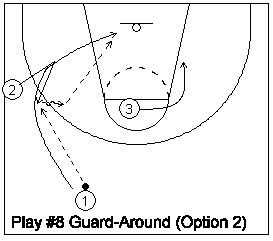
Guard Around - Second Option

Guard #1 passes to #2 who turns toward the free-throw lane, takes one dribble, jumps in the air, and hooks a pass to #1 who cut by him.

Guard Around Basketball Play

Guard Around - Third Option:

Guard #1 passes to Forward #2 who flips the ball back to #1 as in Option 1, but this time #2 rolls to the basket expecting a return pass from Guard #1.

Guard Around Basketball Play

Guard Around - Fourth Option:

Guard #1 passes to #2 who takes one dribble, pivots, and passes back to #1 who cut around him to the basket.

In the guard-around play, the player with the ball may hand off to a teammate crossing behind him and set a lateral screen, or a player can set a lateral screen for the dribbler as the dribbler crosses behind him. In either case, the screener can stop close to the defender, because the defender can see the screen coming.

When the man with the ball hands off or passes to the dribbler and sets a lateral screen, he should stop and use an offensive roll immediately after the teammate move by him. Stepping imperceptibly toward the second opponent, in the direction of the end line, with the foot nearest the end line he pivots on that foot, away from the opponent he has screened. With this move he avoids causing any contact and obtains and holds an inside advantage on the opponent if there is a defensive switch, His pivot foot steps directly toward the basket. He should continue toward the basket quickly with his inside hand up as a target for a pass if the defensive switch occurs, the best passing lane opens immediately after the defensive exchange is made.

Guard Around Basketball Play

Guard Around - Fifth Option:

Guard #1 passes to #2 and cuts outside. #2 catches the ball with a jump stop, pivots, fakes a pass to #1, and dribbles inside to shoot.

Guard Around - Lateral Screen Guard for Guard:

1 passes to 2, then set a lateral screen on X2, 2's defender. 2 on moving to meet the pass, dribbles hard to his left off the screen. As 2 begins his drive, 1 slides his left foot imperceptibly toward the left corner. It is a very slight adjustment. As he makes this slide, X2, moving to stay with 1, bumps into 2, causing him to pivot on his left foot. 1 then takes a long 180-degree-arc swing with his right foot so that he steps directly toward the basket. He is now in front of X2. 2 makes a return pass to 1 if X1 switches. The lateral screen is set with 1's body perpendicular to the direction of X2's body.

Guard Around - Lateral Screen Forward for Guard:

Forward 3 has passed to guard 1 and set a lateral screen on X1. As 1 starts his dribble to the left, shoulder to shoulder off the screen so that X1 can not slide through, 3 slides his left foot slightly forward toward the free-throw lane. As X1 moves moves to stay with 1, he bumps 3. 3 makes a 180-degree-arc swing, pivoting on the left foot and swinging the right leg, stepping toward the basket with this foot. As 1 comes off the screen, X3 switches onto 1 leaving 3 in front of X1 and wide open for a return pass from 1.

Guard Around - Inside or Outside

Guard 2 has the ball and passes to 4. Player 2 has two options. After the pass to 4, he may cut to 4's inside between 4 and 4's defender to receive an inside hand-off or cut to 4's outside and receive an outside hand-off. Player 2 can either shoot, dribble into the basket for a lay-up or dish-off. NOTE: One of the best guards I ever saw play the game used to hit running hook shots from deep in the corner using this play. The hook shot from out here is practically impossible to guard.

Guard Around - High Post with a Screen

Player 2 passes to 4 and fakes away. Teammate 5 starts up from the low post opposite the ball and reverses direction to a medium pivot. Player 4 passes to 5 and follows his pass and sets a screen above the circle. Player 2 reverses and cuts off the screens set by 4 and 5 receiving a pass from 5. Player 2 can take a short jump shot, drive to the basket or kick it back outside.

Trenerjev nasvet II-i: How to coach and teach the two-step rule and the eight basic fundamental plays of basketball


Throughout time, there have been a total of eight basic plays in basketball. In our first article, we discussed the Two-Step rule for receiving the basketball. This article is the beginning of a series of articles covering the eight-basic fundamental plays of basketball. You better bookmark and return often to keep abreast of each new addition to this subject.

Table of Plays

  • PLAY #1 (one-on-One)
  • PLAY #2 (Give and Go)
  • PLAY #3 (Pick and Roll)
  • PLAY #4 (Pick Opposite)
  • PLAY #5 (Scissors Cut)
  • PLAY #6 (Cut Through)
  • PLAY #7 (Shallow Cut)
  • PLAY #8 (Guard Around)


  • Play #1 (One-On-One)

Stationary Moves

After a player catches the ball and squares up to the basket in the triple-threat position, he is in ready to attack his defender. This is so called because the player makes the move from a stationary position, before shooting, passing or putting the ball on the floor. All players should practice one-on-one moves every practice session.

Strong-Side Drive

After catching the ball in the triple-threat position, your attacker should execute a jab step. The purpose is to get the defender to react. This step should be made with the right foot by right-handers and the left foot by left-handed players.

The jab step should be short and quick, only about six inches. If the defender does not react quickly enough to the jab step, the offensive player takes a longer step with the same foot, attempting to get his head and shoulders past the defender. The player then should close the gap and explode to the basket with one dribble.

While teaching stationary moves, emphasize the advantage of using the fewest dribbles possible. Keep the head up and pass-off to a teammate, should the defenders collapse on the drive.

Crossover Step

In the course of making a jab step, the defender responds by sliding in that direction, teach your players to react with a crossover step in the opposite direction with a weak-side drive.

For example, a right-handed offensive player catches the ball, jabs with his right foot, forcing his defender to react, taking away the strong-side drive. The offensive player then crosses the right foot over to the left, stepping by the defender’s foot thereby, putting that defender on his right hip. Teach the importance of keeping the body and ball close to the floor as he brings his shoulders through and steps past the defender and puts the ball on the floor with his left hand.

Once again, the offensive player should always attack the defender by going in a straight line to the hoop. Teaching the fundamentals of effective dribbling of keeping the head up, ball low, and closing the gap is as important in the crossover drive as it is in the strong-side drive. When executed properly, either of these moves can lead to an open jump shot or a lay up.

Jab Step to Jump Shot

Defenders usually adjust to the jab step by taking a step backward to prevent a drive to the basket. This retreat gives the offensive player room to go straight up with a jumper if within his shooting range. Every player has his limits, but they don’t often know what it is. As their coach, it becomes your duty to tell them their limitations. This is the best way I know to end losing streaks and start winning games.

To get his shot off, the offensive player must maintain good balance after executing the jab step. He can do this only by keeping the feet shoulder-width apart and staying low. This is why it is important to keep the jab step short (no more than 6 inches). Too long of a jab step forces the offensive player to reset which allows the defense time to recover and block the shot.

All these stationary moves should be part of every practice session. Coach McCutchan always started every practice with players spending 10 minutes between several stations scattered about the gym. On his whistle, every minute, his players quickly moved to the next station. That guy won 5 Division II National Championships and got him in the hall of fame.

Drills for PLAY #1

There are many team drills for the One-on-One Play. I like to use it in conjunction with the Two-Step Drills given in the following examples. Some are strictly instructional; however, most can be put in competitive drills which can be run many different ways. "Make it – take it" is a good method. That is, if the offense makes the basket, he or the team remains on offense. If the offense fouls, it is a turnover. If the defense fouls, the ball remains with the offense. A specific number of "turnovers" can be set up for the offense with score kept. Losers can do push-ups or laps.

Basketball's Two-Step drill

The Two-Step Moves by Forward to receive the ball. Use both sides of the court for drills. You can reverse the procedure and have the guards use the two-step rule.

Rule: When making a cut without the ball, take two steps away from the direction you are planning to go and then either cut toward the basket or com back to the ball.

Always demand your guards pass-fake to the two-step to freeze the defense. You may add a defensive guard to this drill.

Basketball's Two-Step drill

The Two-Step Moves by all five players. In this case, the Guard is open to receive the ball for an high-percentage open shot.

Rule: When making a cut without the ball, take two steps away from the direction you are planning to go and then either cut toward the basket or com back to the ball.

Always demand your players pass-fake to the two-step to freeze the defense.

Too often, players tend to stand around. The two-step rule teaches them to move without the ball and helps them to understand what you mean when you tell them to read the defense.


  • PLAY #2 (Give and Go)

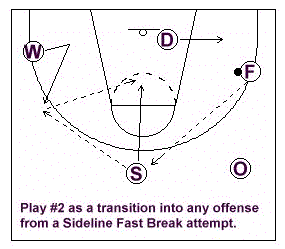
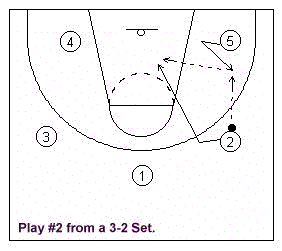
The second fundamental play, like the first, is as old as basketball itself. Again, every one of your players should be fundamentally strong in this play. The following diagrams illustrate Play #2 used in six different offensive sets.

The give-and-go, often called pass-and-cut, is a basic offensive play in which a player simply passes (gives) to a teammate and cuts (goes) to the basket, attempting to break free of his defender and expecting a return pass from his teammate. If the defender moves with the first pass, or turns his head, the ensuing cut should be quick and straight; however, a fake, feint, change of direction, or change of pace may be necessary in order to draw a reaction from the defender. When they see the give-and-go maneuver initiated, other offensive players must decoy their defenders from the basket area and passing lane. If free to receive a pass, the cutter should raise his hand nearest the basket as a passing signal and target. The pass can be a straight pass, a bounce pass, or a lob pass as the situation warrants.

Give and Go from a high post set

Give and go from a 1-3-1 set

Give and go from a 3-2 set

Give and go from a stack set

Give and go from an overload set

Give and go used as a transition into any offense after an unsuccessful sideline fast break attempt.

One of the things I always looked for when scouting an opponent was to see what the guard did after passing to a wing. Even today, most coaches key their offense this way, but fail to utilize one of the easiest ways to score in basketball. The guard brings the ball down court, passes to the forward and cuts through the defense to the opposite side; however, the guard rarely looks for a return pass, because he is simply getting the offense started. What a waste! Any coach who allows his players to do this is passing a great scoring opportunity. Let’s always look for a scoring opportunity and put it in the hoop. I’m sure many coaches call this their first option, but the ball seldom ends up in the cutter’s hands. When the first cutter is a definite threat, defensive help on the other options is lessened.

Drills for Number 2

There are many more drills for the give and go than is shown here. Some are strictly instructional; however, most can be put in competitive drills which can be run many different ways. "Make it – take it" is a good method. That is, if the offense makes the basket, he or the team remains on offense. If the offense fouls, it is a turnover. If the defense fouls, the ball remains with the offense. A specific number of "turnovers" can be set up for the offense with score kept. Losers can do push-ups or laps.


  • PLAY #3 (Pick and Roll)

Go to any playground and watch pick-up games. You will see the best two-man play in basketball. It is a play that most every kid understands; however, this does not mean it is always done right. A good coach makes certain the every fundamental play is executed properly. The pick & roll is no different.

The Basics

If you want to give each of your players a chance to do their best thing, play #3 fits right in. The forward, or guard, can call the screen, either verbally or with hand signals. Signaling is important. Here is the law:

If you desire a pick, call for it. If you are picking for a teammate, signal your intention, either by raising three fingers or calling number "3."

In structuring your patterns, you must understand the pick & roll works best when there is less congestion on that side of the floor. Players on the other side should follow this law:

If #3 is being executed do not bring your defender into the area; however, keep him occupied so he cannot sag and congest the play area. Look for a shot to be taken and try to be in a good rebounding position

Guard-Forward or Guard-Center #3

The guard with the ball should always call this play. He may continue with the ball and use the screen himself, or pass to another guard, or wing, for a pick and roll on their specific side of the floor. The following diagrams show the guard with the ball in various sets in a position to call, play #3.

Play #3 from a three-guard set
Play #3 from a two-guard set

Play #3 from a low-post stack
Play #3 from a one-four high set

Fundamentals of the Pick and Roll

Before you can execute any of these eight fundamental plays, you must understand all the fundamentals of the play. Many teams use the pick and roll, yet fail to get decent shots. There are others, but here are seven reasons this play fails:

  1. The screen is not set on the correct position on the floor.
  2. Improper setting of the screen.
  3. The screen is not held long enough.
  4. Failure of man with the ball to maneuver his defender into the screen
  5. The roll is made incorrectly.
  6. The pass is deflected or intercepted.
  7. One, or both players, fail to take advantage of shifts made by defense.
Setting a Good Screen

The front screen is the most basic and should be taught first. In setting this, the player faces the defender to be screened. The rules allow the screener to set his screen as close as possible as long as the defender can see him. Set the screen to his peripheral side.

The legs of the screen should be wide with knees flexed an arms raised in a defensive stance. This makes your body big and allows the referee to see your hands. Too many players set screens like a telephone pole with hands protecting the crotch. This is wrong. Have the hands in the air, ready to catch the ball once the roll is made.

Making a Good Roll

If the legs are wide at the screen, it is easier to make a wide roll. This helps to screen out the defender on a switch. Make the pivot on the foot nearest the basket throwing the outside elbow toward the basket with hand extended as a target for a pass. The butt should make contact with the defender being screened. This puts the defender on the roller’s back should a switch occur. Contact is necessary for best results. Even if the player with the ball shoots, the roller is in excellent rebounding position because he has the man on his back.

Guard Runs the Defender into the Screen

Success or failure of the pick and roll depends largely upon the player with the ball. There must be an inside maneuver to set up the execution. He must master these five fundamental moves with the ball:

  1. The cross-over step
  2. cross-over dribble
  3. behind the back dribble
  4. reverse dribble
  5. between the legs dribble

RULE: The player with the ball is responsible to run his defender into the pick once the screen has been set.

Improper Placement of the Screen

If the screen is not set in the proper place on the floor, the defense can easily adjust or does not need to adjust at all. When set in the middle of the floor, the roll is into a congested area. The defense can help and recover too easily. When a pick is set outside, or on a clear side, the defense must make more adjustments, or give up a shot. If the screen is set too far outside, the guard may have a shot beyond his range, then no switch is necessary.

RULE: If the guard is dribbling, let the guard make an inside move first, before setting the screen. Then, let the guard drive his defender into the screen.

Setting a Wide Screen

Another reason the pick and roll fails is because the screen is not wide enough. The screen, whether it be a front or back screen, should be set wide. The feet should be wider than the shoulders, yet the knees should be flexed to take the contact. If the screen is not wide enough, the defense can go over the top or slide through too easily.

If the screen is wide, the screener will take his first step wide to the basket. This also prohibits the defense from switching well enough to cover the roll. The long step produced by the wide screen keeps the defensive guard and the offensive forward’s back. The short step allows the defense to front the roller with less difficulty.

Hold the Screen Long Enough

The screen must be held long enough that the defending guard is screened out of the play. Too many times the forward rolls before the guard is screened and no switch is needed to defend the play.

RULE: The screen should be held until the offensive ball handler is past the screen. The guard should be out of the peripheral vision of the roller before he executes his roll.

Release too early and the play fails; however, if the screen is wide and the switch is made, it really makes no difference when the roll is made. The offense should have the advantage because a guard will now be defending a forward. Even if a shot is taken from the outside, the offense has a better advantage of rebounding a missed shot. If not, the guard can take the ball to the corner and the forward can post up down low with a small defender on his back.

RULE: If the switch is made, especially a jump switch, the guard should try to take the defensive forward to the corner and the offensive forward should post his smaller opponent.

The Incorrect Roll

For some reason, many players turn rather than roll to the basket. A "turn" is a front pivot rather than a reverse pivot. A front pivot turns the offense into the defensive guard causing a moving pick. Also, the forward takes his eyes off his teammate who has the ball. The roll gets you to the basket quicker because the first step is toward the basket. The roll causes the defensive guard to be behind the forward rolling toward the basket. Players must be drilled early in the proper execution of Play #3.

The Incorrect Pass

Whenever a player passes through a defender on any offensive situation, either of two passes may be executed, a bounce pass or a high pass.

RULE: Use only the high pass or a bounce pass in executing the pick and roll.

Defending Play #3

There are four basic ways to defend the pick and roll:

  1. No switch
  2. Jump switch
  3. Slide through
  4. Help and recover

No Switch

Whether this method is used or not, it should be practiced, especially early in the season. Aggressive players are necessary. Players should be talking constantly on defense and the guards must be quick and have the ability to change directions quickly. Defensively, the "no switch" is the best because the defense never gets involved in a mismatch.

The defensive guard must learn how to beat the screen. To go over the top: step-up, belly-up, and go over the top.

Whenever the defensive forward sees his man going to set a screen, for example, he should, instead of calling "screen left," he should shout, "step-up left." This helps to remind the guard to step-up with his left foot in order to beat the screen. This generally takes a couple of short quick steps to get in front of the screen. Then, the defending guard throws his hip and stomach forward and slides over top of the screen. Using the hand nearest the screen also helps him to find the screen.

RULE: Call out screens when your man is setting a screen. Use "step-up right" when the screen is on the right and vise versa.

If your opponent’s offense isn’t strong, you can beat many screens this way, especially if the defense is communicating properly. Talking on defense is one of the most important factors in any good defensive team. Players must be drilled on this and penalties assessed to players not conforming, especially early in the season. Bench time, or laps, usually work.

Jump Switch

If you choose to switch, the jump switch, if executed properly, is best. If properly executed, you may draw a charge, trap the ball, or cause a turnover.

For example, say you have been going over the top, usually the defense tries to adjust. Sometimes a change to the jump switch will often catch a very good offensive player off guard and cause an error.

The jump switch is just that. The defensive forward, or guard, makes a quick sideways move in front of the dribbler. The most common mistake is that the jump fails to make the dribbler alter his direction. In fact, they have accomplished what they wanted – a mismatch or a defensive player out of position. If the switch is made properly, the offensive guard must stop, change direction, or charge.

RULE: If you jump switch, jump completely to the outside of the dribbler.

Most dribblers do not come close enough to the screen because they are driving hard to the outside. If a switch is made, they continue hard, but may have to move farther outside. Very few dribblers come back to the pick side when a screen is set for them. If the jump switch is hard and far enough, an error generally happens the first time.

This defensive action works better if the ball handler is weak; however, even good ball handlers are usually best with their strong hand. I always instructed my players guarding a dribbler to stay on his strong side.

RULE: If it is a guard to guard pick, always jump switch.

The Slide Through

Some coaches prefer to defend against the pick and roll by having the defensive forward step back and help the defensive guard through. Unless the guards shoot from the outside, this is not the best defensive option against the pick and roll.

Help and Recover

This is a combination of the no switch and jump switch defensive options. No switch is really involved. The defensive move made by the guard is "belly-up and over" while the forward uses the "helping" move. Do not teach this one until the no switch and jump switch has been taught.

The defensive forward should be outside as if ready to jump switch. This forces the offensive guard to go outside a little farther off the screen and helps the defensive guard to "belly-up and over.

DRILLS FOR NUMBER 3

There are many more drills for the pick and roll than is shown here. Some are strictly instructional; however, most can be put in competitive drills which can be run many different ways. "Make it – take it" is a good method. That is, if the offense makes the basket, he or the team remains on offense. If the offense fouls, it is a turnover. If the defense fouls, the ball remains with the offense. A specific number of "turnovers" can be set up for the offense with score kept. Losers can do push-ups or laps.

Pick & Roll chair drill for forwards

Pick & Roll Chair Drill for Forwards

  • The forwards line up along the baseline
  • Guards line up near center line. The two front guards have a ball in the position as shown.
  • The two front forwards (3 & 4) are in their starting position.
  • A coach is on both sides of the floor and chairs are placed as shown in the diagram near the free throw line.
  • The coach calls for the forward to come up and set a screen.
  • The forward must wait for the guard to drive before rolling.
  • The coach has guards to alternate timing, checks, and corrects any faults.
  • All faults must be eliminated before using any defense.
  • The screen must be set close to the chair so the "turn" is prohibited.
  • A good pivot is produced. In the beginning no balls are used, just the pivot on the chair.


  • PLAY #4 (Pick Opposite)

Back about 1959, Pete Newell used the backdoor trap. Later, Ed Jucker of Cincinnati fame refined it by swinging the pattern from side to side. Cincinnati’s Backdoor Trap series had one purpose: to give his big men at the forward and post position tremendous scoring power in close to the basket. We all know the easiest way to score is to get a player open under the basket and give him the ball. All eight fundamental plays have this in common; however, one of the most popular moves in the past century was this backdoor trap which later evolved into the flex offense.

I like the pick-opposite because it gets players moving without the ball on the weak side of the court and helps players in receiving a pass while in motion. The screen often causes mismatches when the defense switches to counter the movement. This play can be run from any offensive formation. Only a few are shown here:

Play #4 from a 3-2 Offensive Set

Play #4 from a High Post Offensive Set

Play #4 from a 1-3-1 Offensive Set

Play #4 from a High 1-4 Offensive Set

SETTING A GOOD SCREEN

Many of the same fundamentals for plays #2 and #3 are the same for play #4. The screen must be wide and must be set on the defensive player, no matter where the offensive teammate is on the court. Since the screener will be facing the defensive man, he can set the screen as close as needed without touching him. The screener’s knees should be flexed and ready for contact.

Use a roll to widen the screen. The roll can be a reverse pivot in the direction taken by the defensive man. This gives the screener good rebounding position or leaves him open for a return pass. Whenever the screen forces a switch, you know a good screen has been set.

PLAY #4 OPTIONS

Players may receive the ball at the low post, medium post, or high post. Different shots must be mastered from all three positions, even though it is designed primarily to get the ball to a man at the low post.

When breaking off a #4 or flashing to the post players must come to the ball hard and come to a jump stop. This way, either foot can be the pivot foot. The screener should always open toward the ball as he, more often than not, is the most often open for a good shot

DRILLS FOR PLAY #4

Close-out pivot chair drill

Close-out pivot chair drill

Use a chair to practice close-out pivot to open up for a pass. As the players break to chair, reverse or close-out pivot, and break back for the pass. Note: two steps should be taken.

Forwards dribble & close-out pivot

Give all forwards a ball to practice the dribble-up and close-out pivot. All dribble and come to a jump-stop. On command they all step toward the coach and prepare to hand off.

Forwards dribble & close-out pivot

Two-man close-out pivot Drill

Two-man close-out pivot Drill

Forward starts with ball and dribbles to the free throw area and comes to a jump stop.

1. Guard goes outside

2. Guard goes inside

3. Guard goes either way

4. Add defense on guard

5. Add defense on forward